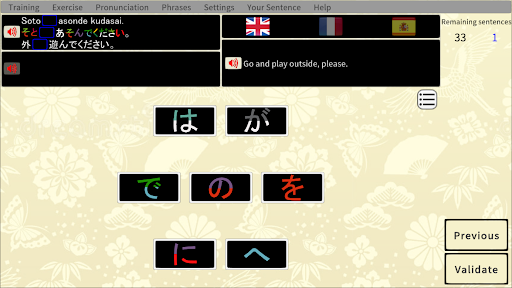
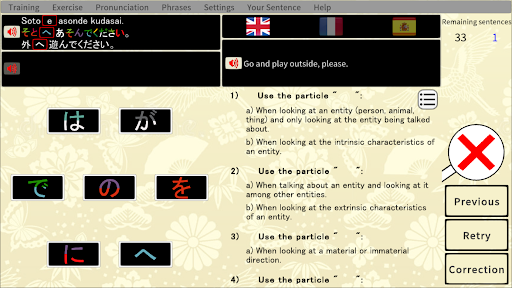
The purpose of this software is to highlight the fundamental systems that govern THE USE OF THE MAIN PARTICLES IN THE JAPANESE LANGUAGE.
What we propose here does not claim to cover exhaustively all the uses of all particles, because there are of course exceptions and counterexamples, but the fundamental uses are clearly presented and explained and are easy to understand.
In order to offer a different perspective on learning, we have chosen to rely on the basic principles of the Gattegno pedagogical approach.
We defend the principle that grammars, whatever they may be, are derived from usage and that usage itself is derived from points of view and messages that are conveyed.
The correct use of particles is crucial in Japanese and in that sense can be somewhat associated with the way in which conjugation works in the French language.
Making a mistake in a conjugation is not only very unpleasant to hear, but can also be confusing, and therefore impede understanding.
In the Japanese language, for example, it is not uncommon to encounter sentences like:YUKI WA FURU or YUKI GA FURU (it snows)FUJI SAN WA KIREI or FUJI SAN GA KIREI (Mt.
Fuji is beautiful) MISE WA SHIMATTEIRU or MISE GA SHIMATTEIRU (the shop is closed) TOKYO DE UMARETA or TOKYO NI UMARETA (I was born in Tokyo) KORE WO TABETAI or KORE GA TABETAI (I want to eat that)As you can see, the preceding sentences are declined with different particles, although they are translated in the same way in French, English, and Spanish.
These sentences are of course perfectly correct in Japanese and in their translations, but for each of them, the particle changes the point of view and therefore the message also differs.
https://andro.io/app/waga-1o5jn
 Power 100


Android app profile
WAGA for Android – Latest Version & Features
★★★★★
(0 ratings)
Rate this app
How do you feel about WAGA?
Thanks for your feedback!
> 2.2k
Monthly Downloads
~$900
Estimated Cost
Screenshots