
The Pomodoro Technique is a time management method developed by Francesco Cirillo in the late 1980s.[1] It uses a kitchen timer to break work into intervals, typically 25 minutes in length, separated by short breaks.
Each interval is known as a Pomodoro, from the Italian word for tomato, after the tomato-shaped kitchen timer Cirillo used as a university student.Its really simple to use:The original technique has six steps:Decide on the task to be done.Set the Pomodoro timer (typically for 25 minutes)Work on the task.End work when the timer rings and take a short break (typically 5–10 minutes)Go back to Step 2 and repeat until you complete four Pomodoros.After four Pomodoros are done, take a long break (typically 20 to 30 minutes) instead of a short break.
Once the long break is finished, return to step 2.For the purposes of the technique, a Pomodoro is an interval of work time.For the purposes of the technique, a Pomodoro is an interval of work timeRegular breaks are taken, aiding assimilation.
A 10-minute break separates consecutive pomodoros.
Four Pomodoros form a set.
There is a longer 20–30-minute break between sets.A goal of the technique is to reduce the effect of internal and external interruptions on focus and flow.
A Pomodoro is indivisible; when interrupted during a Pomodoro, either the other activity must be recorded and postponed (using the inform – negotiate – schedule – call back strategy) or the Pomodoro must be abandoned.After task completion in a Pomodoro, any remaining time should be devoted to activities, for example:Review your work just completed (optional)Review the activities from a learning point of view (ex: What learning objective did you accomplish?
What learning outcome did you accomplish?
Did you fulfill your learning target, objective, or outcome for the task?)Review the list of upcoming tasks for the next planned Pomodoro time blocks, and start reflecting on or updating them.Cirillo suggests:Specific cases should be handled with common sense: If you finish a task while the Pomodoro is still ticking, the following rule applies: If a Pomodoro begins, it has to ring.
It’s a good idea to take advantage of the opportunity for overlearning, using the remaining portion of the Pomodoro to review or repeat what you’ve done, make small improvements, and note what you’ve learned until the Pomodoro rings.The stages of planning, tracking, recording, processing and visualizing are fundamental to the technique.
In the planning phase, tasks are prioritized by recording them in a "To Do Today" list, enabling users to estimate the effort they will require.
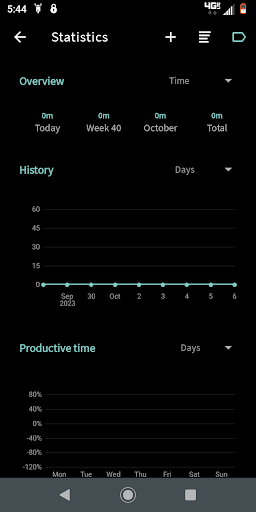
As Pomodoros are completed, they are recorded, adding to a sense of accomplishment and providing raw data for subsequent self-observation and improvement.
https://andro.io/app/pomodoro-1nud5



Android app profile
Pomodoro Timer for Time Manage for Android – Latest Version & Features
by IJAGER
Power 100
Rate this app
How do you feel about Pomodoro Timer for Time Manage?
Thanks for your feedback!
> 2.2k
Monthly Downloads
~$900
Estimated Cost
Screenshots